
Short answer: Chefchaouen is not near Marrakech — it is about 600 km away, too far for a day trip. Our 5-day tour from Marrakech to Chefchaouen starts at €390 per person.
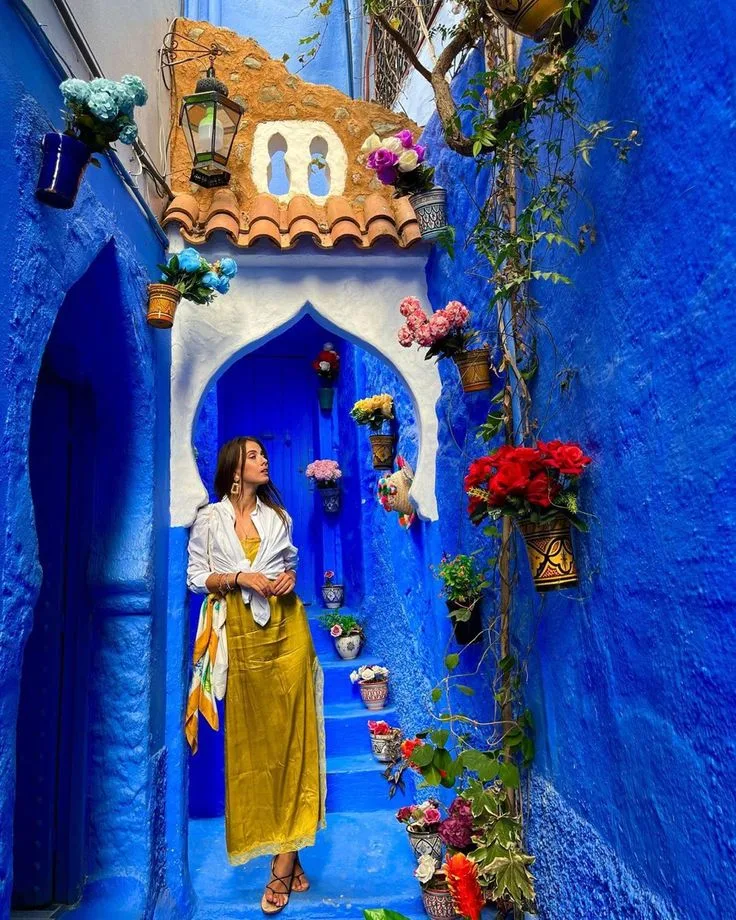
Chefchaouen sits in the Rif Mountains in northern Morocco, several hundred kilometers from Marrakech, and it looks unlike anywhere else in the country. Nearly every wall, staircase and doorway in the old medina is painted some shade of blue, from pale sky to deep indigo, a tradition with roots that locals explain in a few different ways — some point to a Jewish community that settled here decades ago, others to the color’s association with keeping insects away or simply its calming effect in the mountain heat.
Getting to Chefchaouen from Marrakech
Given the distance, Chefchaouen is realistically a stop within a longer northern Morocco itinerary rather than a standalone day trip. Our 5-day Marrakech to Chefchaouen tour covers the route properly, breaking up the distance with stops rather than one long drive, and our 10-day Morocco tour combines it with the Sahara and Fes for a full loop of the country’s highlights.
What to Do in the Medina
Wander Without a Fixed Route
Chefchaouen’s medina is small and genuinely safe to get lost in on purpose — every turn reveals another photogenic staircase or courtyard, and unlike Marrakech’s souks, the pace here is unhurried with far less pressure to buy.

Plaza Uta el-Hammam
The main square anchors the medina, flanked by the old kasbah and its small museum and garden, a good spot to sit with a coffee and get oriented before wandering further.
Ras El Maa Waterfall
A short walk to the edge of the medina brings you to this small waterfall and spring, historically the town’s main water source, still used by locals for washing wool and rugs.
Hiking Around Chefchaouen
The surrounding Rif Mountains offer genuinely good hiking, particularly toward the Spanish Mosque on a hillside above town, a roughly 45-minute to an hour walk that rewards you with the best panoramic view over the blue medina, especially at sunset. More ambitious hikers can continue further into Talassemtane National Park for pine forests and rock formations.
Photography Tips
- Early morning (before 9am) gives the softest light and fewer people in your shots
- Rue Targhassa and the streets just off the main square are the most consistently photogenic
- Ask before photographing doorways with people or laundry outside — it’s still someone’s home
- The Spanish Mosque viewpoint is best for sunset, not midday
- Wear shoes with good grip; medina steps are steep and often uneven
What to Pack
- A warm layer, since the mountain altitude keeps evenings cool even in summer
- Comfortable walking shoes for steep medina stairs
- A light rain jacket if visiting outside summer, as the Rif sees more rainfall than the south
- A crossbody bag for hands-free photography
- Cash for small medina purchases, since card acceptance is inconsistent
Best Time to Visit
Spring and autumn offer the most comfortable hiking and walking weather. Summer is warm but far less intense than Marrakech given the altitude and northern location. Winter can be cold and wet, though the town takes on a quieter, moodier character with fewer visitors, and a light dusting of snow on the surrounding Rif peaks against the blue walls is a scene few visitors ever plan for but rarely forget once they see it.
Chefchaouen’s medina and surrounding Rif region reflect the cultural diversity Wikipedia’s entry on Morocco describes across the country’s different regions, and it genuinely feels like a different Morocco from the ochre tones of Marrakech and the south.
Food and Local Life in Chefchaouen
Chefchaouen’s food scene reflects its Rif mountain setting more than the tagine-and-couscous expectations most visitors bring from further south. Goat cheese from local farms shows up on menus here in a way it rarely does elsewhere in Morocco, along with hearty mountain stews and fresh bread baked in communal ovens tucked into the medina’s side streets. Cannabis cultivation has historically been part of the wider Rif region’s economy, and while it’s still technically restricted, its presence is an open secret locally and occasionally comes up in casual conversation with vendors — it’s not something the town is built around for visitors, but it’s part of the honest picture of the region.
Life in the medina moves at a genuinely slower pace than Marrakech, with fewer persistent vendors and more families simply going about daily routines around you. Evenings on Plaza Uta el-Hammam, with the kasbah lit up and cafés filling the square, give a good sense of how the town actually lives once the day-trip crowds thin out.
Combining Chefchaouen with the Rest of Morocco
Because of the distance from Marrakech, Chefchaouen makes most sense as part of a longer circuit rather than a rushed add-on. Travelers doing our 10-day route typically experience the Sahara desert first, then head north through Fes before finishing in Chefchaouen, which spreads out the long drives sensibly rather than backtracking.
If you’d like help mapping Chefchaouen into a longer Morocco itinerary, or want to know how the 5-day and 10-day routes differ, email contact@moroccobestdestination.com or call +212 661-757505 and we’ll walk you through the options.
Is there a blue city in Marrakech?
No — the famous “blue city” of Morocco is Chefchaouen, in the Rif mountains of the north, about 8 to 9 hours’ drive from Marrakech (or 3.5 to 4 hours from Fes). The blue you may have seen in Marrakech is the Majorelle Garden, painted in “Majorelle blue”. The easiest way to see the real blue city from Marrakech is to include it in a tour through the Sahara and Fes.
Visit Chefchaouen with us
Our 5-day tour from Marrakech to Chefchaouen crosses the Atlas, spends a night in the Merzouga dunes and reaches the blue city via Fes, with a night in a riad in the medina. For a longer trip, the 10-day Morocco tour adds Rabat and Casablanca. Flying into Tangier? See our Tangier to Chefchaouen transfers.